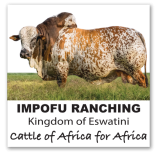

For hundreds of years the indigenous cattle of Africa have been exposed to the rigours of natural selection. They have developed resistance to many tickborne diseases and other environmental constraints such as drought, with the shortage of water and grass this brings, and they have developed a tolerance to extreme heat and cold.
Indeed, after the Boer War of 1899-1902, the British found a wild population of Nguni cattle inhabiting the old 100,000 acre Forbes Ranch, which is now known as Hlane. These cattle ran with wildebeest and other wild animals, developing a resistance to the dreaded “snotsiekte” and other diseases, and adapting to an existence of survival of the fittest. When cattle dipping became mandatory to control the ticks because imported cattle could not cope on our African range, the decision was made to destroy this wild population of pure Ngunis on Forbes Ranch because they could not be dipped. A common feature of every Nguni destroyed, was the absence of ticks. The destruction of these environmentally naturally adapted animals was, without question, one of the most foolish decisions by so called livestock “improvers” that was ever made. This is so because more than 100 years has since been spent trying, without success, to control ticks with various dipping compounds, to which ticks successfully build their own resistances. So what was all handed down to us on a plate by Nature was destroyed – and we have had to live with the very costly consequences ever since. To make matters worse, the dipping compounds originally used killed the ox-pecker birds which served so well as Nature’s tick controlling agent.
In Africa what is needed in livestock production is cost-effective management. This implies minimal management, which suits our local conditions perfectly. By not embracing those naturally adapted animals we inherited from our forefathers, we have escalated the costs of management and intensified the need to what now amounts to over-management of our livestock.
Furthermore, modern “livestock improvers” kept trying to alter native cattle by crossing them with foreign breeds to make them bigger. They also selected as breeding stock the heaviest animals, considering them to be the best. This has diluted the purity of indigenous cattle breeds and negatively impacted on the values of centuries of natural selection. This in turn has impacted negatively on the cost-effectiveness of livestock production.
Bigger is not better!
Nature does not tolerate extremes – it is the “middle of the road” sized animals that cope best under challenging natural conditions.
While it is totally logical to concentrate on enhancing the protein production values of any breed, it is equally important to do so while retaining the enormous genetic value of naturally adapted animals, which are able to cope with Africa’s many hostile environmental constraints; the better we are able to do this, the more cost-effective it potentially becomes. We believe that the most important selection factor is fertility – a cow that can produces a good calf every year is invariably not above average in size.
The pure Nguni and Boran are both well adapted to African conditions and therefore more cost-effective livestock prospects. Both these breeds mature at a younger age and live longer, more productive lives than foreign or cross bred animals. They are tougher and survive better under challenging conditions such as disease challenges and droughts, and they make better use of natural vegetation, being both grazers and browsers. They are not as large as the more “developed” breeds, but a greater number of them can be kept on a given area of land – and we believe, if properly analyzed, they will produce more kg/ha.
About Impofu Ranching
Impofu Ranching is a leading cattle breeding operation based in Eswatini, dedicated to preserving and promoting indigenous Boran and Nguni cattle through sustainable, natural breeding practices. With a strong focus on conservation, genetic excellence, and the cultural heritage of African cattle, Impofu Ranching supplies top-quality livestock for local and international markets. Whether you’re a farmer, conservationist, or cattle enthusiast, connect with Impofu Ranching to explore how their superior breeding programs can benefit your herd. For more information, reach out to Liz Reilly at +268 7602 1275.